

There is a phrase in Bitcoin that I think about a lot as a professional fighter: Proof of Work.
At first, it sounds like a technical term that belongs to computer scientists, miners and people who spend their days studying Bitcoin’s code. But the more I learned about Bitcoin, the more I realized that Proof of Work is built around an idea I have understood for more than two decades:
You don’t get to claim the result without putting in the work.
That is something I understand very well.
I have spent more than 20 years competing in mixed martial arts. Before the championships, before the records, before people called me one of the greatest female fighters in MMA history, there were thousands of hours of training that nobody saw.
There were early mornings, hard sparring sessions, wrestling rounds, strength and conditioning, injuries, losses and countless repetitions of the fundamentals.
The results became visible later.
That is why Bitcoin’s Proof of Work concept immediately made sense to me.
What Is Proof of Work in Bitcoin?
Bitcoin is a decentralized monetary network. There is no CEO, bank or central authority deciding which transactions are valid or simply declaring which version of the ledger everyone should accept.
Instead, Bitcoin uses a combination of cryptography, economic incentives, a peer-to-peer network and Proof of Work to secure its blockchain.
The blockchain is essentially a public, chronological ledger of Bitcoin transactions. Transactions are grouped into blocks, and miners compete to add the next valid block to the chain.
This is where Proof of Work comes in.
Bitcoin miners use specialized computers to perform enormous numbers of calculations. They repeatedly change a value called a nonce and hash the block data until they find a hash that satisfies the network’s current difficulty requirement.
The important part is that finding a valid result requires substantial computation.
But once somebody finds it, everyone else on the network can verify the answer relatively easily.
That asymmetry is extremely important:
Hard to produce. Easy to verify.
That is Proof of Work.
Bitcoin.org describes mining as the process of using computer hardware to perform mathematical calculations that confirm transactions and increase the security of the network. Miners compete based on the amount of computation they perform and receive block subsidies and transaction fees for their work.
Why Does Bitcoin Need Proof of Work?
One of the biggest challenges with digital money is preventing someone from simply changing the history.
If I send you digital information, I can potentially make a copy of that information. Bitcoin needed a way to create digital scarcity and establish an agreed-upon history of transactions without relying on a central authority.
Proof of Work makes rewriting Bitcoin’s transaction history extraordinarily expensive.
Each block is connected to the previous block through cryptographic hashes. Changing an older block would require redoing the Proof of Work for that block and the blocks that came after it, while also competing against the continuing work of the rest of the network.
That means Bitcoin’s history isn’t protected because somebody says, “Trust me.”
It is protected by mathematics, computation, energy and economic incentives.
That distinction is one of the things I find most fascinating about Bitcoin.
Proof of Work Makes Me Think About MMA
When I look back at my career, I can see a similar principle.
People see the belts.
They see the victories.
They see the knockouts and submissions.
They see the championships.
They see the record.
But those things are the result. They aren’t the work itself.
My professional MMA record is currently 29-2, and I have won world championships in every major organization where I have competed. My career has included victories over some of the greatest fighters in women’s MMA history. PFL has documented my championships, longevity and record of finishes throughout my career.
But none of those accomplishments happened because I simply wanted them.
They required Proof of Work.
Every championship was preceded by a training camp.
Every fight was preceded by thousands of repetitions.
Every improvement came from doing the work again and again.
And every loss taught me that the work doesn’t stop simply because you have already accomplished something.
That is the mentality I bring into every camp.
Bitcoin Doesn’t Care About Your Reputation
There is another part of Proof of Work that I find particularly interesting.
Bitcoin doesn’t care who you are.
A miner doesn’t get to say, “I’ve been mining for 20 years, so give me the next block.”
Your reputation doesn’t create a valid block.
Your résumé doesn’t create a valid block.
Your intentions don’t create a valid block.
The work has to satisfy the rules.
That reminds me of fighting.
When the cage closes, my previous championships don’t win the fight for me.
The opponent doesn’t care how many belts I have.
The clock doesn’t care how many fights I’ve won.
The referee doesn’t award points because of my reputation.
I still have to perform.
I still have to solve the problems in front of me.
I still have to earn the result.
That is one reason I believe the Proof of Work concept resonates so strongly with me.
Proof of Work Is Not Just “Working Hard”
There is an important distinction here.
Proof of Work doesn’t simply mean that miners are working hard.
It is a specific technical mechanism.
Bitcoin miners are searching for a valid hash that meets a target determined by the network’s difficulty. The network adjusts difficulty so that blocks continue to be produced at approximately the intended rate despite changes in the amount of mining power participating in the network.
So when Bitcoiners talk about Proof of Work, they aren’t using “work” as a motivational slogan.
They are describing a measurable computational process that helps secure consensus.
The work has a verifiable outcome.
That is what makes the concept so powerful.
The Energy Is Part of the Security Model
Proof of Work is also why Bitcoin uses energy.
This is an important part of understanding Bitcoin rather than simply repeating talking points about it.
Bitcoin’s security model intentionally makes certain attacks expensive because obtaining and controlling enough computational power requires real-world resources.
Bitcoin.org describes the network’s security as relying on both cryptographic signatures and the energy expended through Proof of Work.
The energy isn’t there because Bitcoin needs computers to perform meaningless calculations.
The computation is part of the mechanism that makes manipulating the network costly.
That is a major difference between simply writing information into a database and maintaining a decentralized monetary network where participants do not have to trust a central administrator.
My Next Test of Proof of Work
On Saturday, August 22, I return to the cage at PFL Tampa to face Ketlen Vieira.
The PFL has officially confirmed the fight as the main event at Benchmark International Arena, with the main card scheduled for 9:00 p.m. ET live on ESPN in the United States.
I enter that fight with 29 professional MMA victories.
That means one of the biggest numbers surrounding this fight is 30.
With a victory over Ketlen Vieira, I would become the first woman in professional MMA history to reach 30 professional victories.
For me, that isn’t simply another number.
It represents decades of Proof of Work.
But there is something important I have learned through Bitcoin:
The work comes before the proof.
You cannot manufacture Proof of Work after the fact.
You cannot go back and pretend you trained when you didn’t.
You cannot rewrite the blockchain because you wish the history were different.
And you cannot rewrite a career.
The record is the record.
The blockchain records its history.
A fighter builds hers.
Why Bitcoin and MMA Make Sense Together
I don’t think Bitcoin is valuable because someone tells you that it is.
I think it is worth learning about because the system is fascinating.
Bitcoin allows anyone to study the rules, verify transactions and participate in an open monetary network. Its blockchain provides a shared public ledger, while Proof of Work provides one of the mechanisms used to establish and protect that history.
For me, the connection to MMA is simple.
Discipline.
Competition.
Transparency.
Rules.
Verification.
Work before reward.
Those principles have been part of my life long before I learned about Bitcoin.
Now, when I think about Proof of Work, I see something familiar.
A miner keeps working until it finds the solution.
A fighter keeps training until she is ready.
The miner cannot fake the computation.
The fighter cannot fake the preparation.
And ultimately, both are judged by what they can prove.
My Bitcoin Lesson
If you are new to Bitcoin, don’t start with the price.
Start with the technology.
Learn what the blockchain is.
Learn what mining is.
Learn what Proof of Work means.
Learn why Bitcoin uses cryptographic signatures.
Learn how the network reaches consensus without a central authority.
Then make up your own mind.
Bitcoin is much more interesting when you understand why it works instead of simply watching the price go up and down.
I have spent my career learning that the strongest results come from understanding the fundamentals and doing the work consistently.
That is why Proof of Work is more than a Bitcoin phrase to me.
It is a concept I can relate to.
Twenty-one years of MMA have given me plenty of experience with it.
And on August 22 in Tampa, I get another opportunity to put that philosophy to the test.
29 wins.
One more opportunity.
Thirty is the goal.
That’s Proof of Work.
— Cris “Cyborg” Justino
18x MMA World Champion
If you would like to learn more about Bitcoin then you need to attend the Bitcoin conference 2027 taking place July 16-18th in Nashville TN. Use Discount promo code: CYBORG and you will save 10% on all Bitcoin 2027 tickets. This is the best discount code to use to receive cheap tickets because it is easy to remember!


Latest from the blog
Thursday, 1st Oct, 2026
PFL-MVP Shakeup Creates New Questions for MMA Free Agents
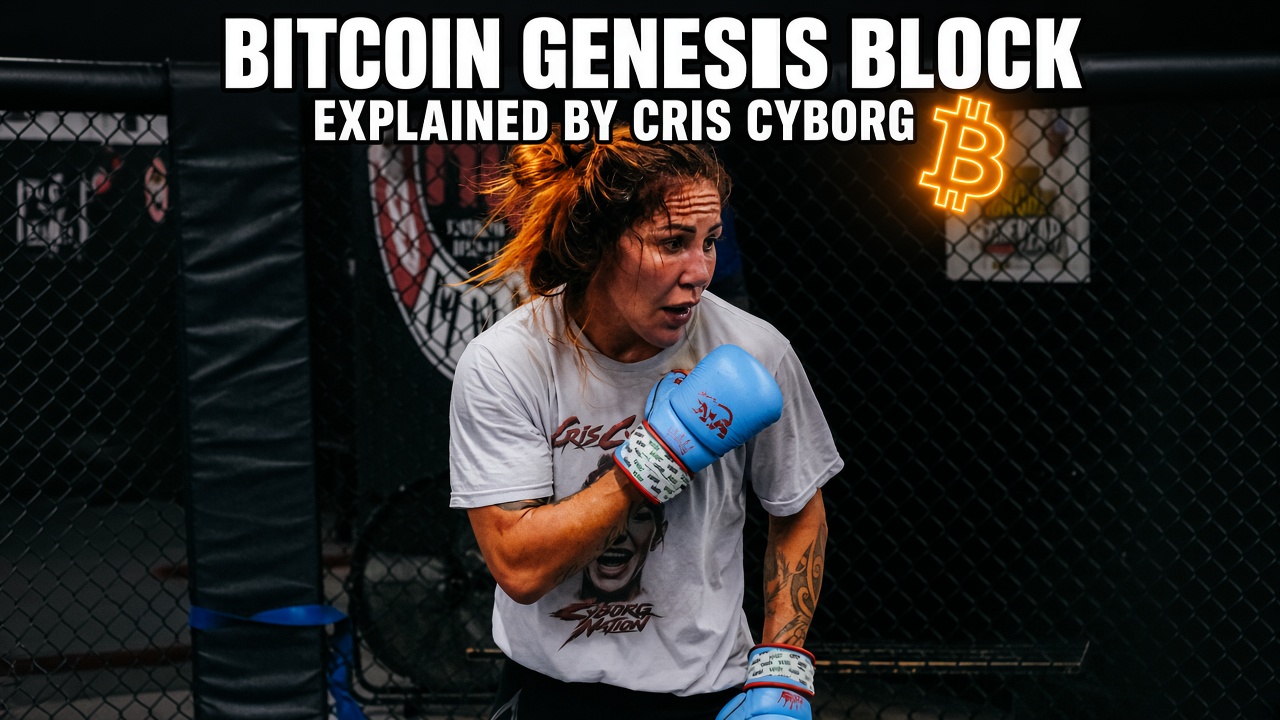
Bitcoin Genesis Block Explained: What Satoshi’s First Block Really Means

The Future of Brain Health in MMA

Heather Hardy’s $10 Million Lawsuit Exposes Most Valuable Promotions’ Pattern of Prioritizing Spectacle Over Safety

UFC Vegas 121 Results: Rosas Jr. Wins War, But Night Overshadowed by Barcelos Medical Scare

How to Read Bitcoin Price Charts: Why Time in the Market Matters More Than Timing the Market
You might also like
Saturday, 21st Mar, 2020
Cris Cyborg QUARANTINE BootCamp in home no weights workout is free Mon-Fri 10am PST until April 1st

Whindersson Nunes challenges Logan Paul to a boxing match and then says it would be an honor to promote Cris Cyborg on the event

Bitcoin Asia 2025 Conference Hong Kong Ticket enter discount promo code: CYBORG to save on tickets

Cris Cyborg Cloth Face Coverings for children’s charity completely sold out in 2 hours

Sean Brady takes decision win over Gilbert Burns UFC Fight Night